
Why GLP-1 Drugs Alone Aren’t Enough for Sustainable Weight Loss
Share
Introduction
GLP-1 medications like semaglutide and liraglutide have changed the conversation around weight loss. For the first time, millions of people are experiencing meaningful appetite control and rapid reductions in body weight.
But there’s a growing problem few are talking about:
GLP-1 drugs alone rarely lead to sustainable, long-term metabolic health.
Patients lose weight — but often lose muscle, energy, and metabolic resilience along the way. Many struggle with fatigue, nausea, nutrient depletion, and eventual weight regain once therapy stops.
The truth is simple but inconvenient:
GLP-1 medications are a powerful tool — not a complete solution.
What GLP-1 Medications Actually Do
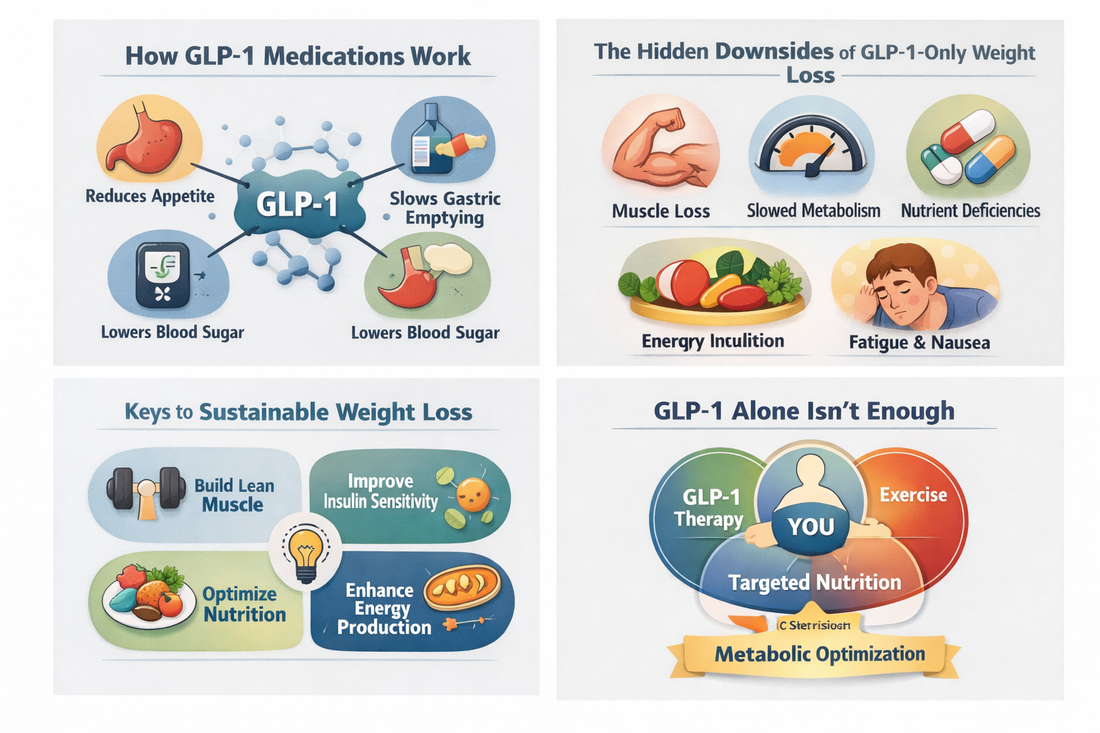
GLP-1 (glucagon-like peptide-1) receptor agonists work by:
Slowing gastric emptying
Reducing appetite and food intake
Improving glucose control
Enhancing insulin response
These effects are extremely effective for reducing caloric intake, which explains the dramatic short-term weight loss many patients see. However, appetite regulation and metabolism are influenced by multiple hormonal pathways, not just GLP-1 signaling.
But GLP-1s do not:
Optimize metabolic efficiency
Preserve lean muscle mass
Support mitochondrial function
Correct underlying insulin resistance
And that’s where problems begin.
The Hidden Limitations of GLP-1-Only Weight Loss
1. Muscle Loss Is Common — and Dangerous
Rapid weight loss without adequate metabolic support often leads to loss of lean body mass, especially during GLP-1–assisted weight loss.
Muscle is not cosmetic — it is metabolically active tissue that:
Regulates glucose disposal
Maintains resting metabolic rate
Protects long-term weight stability
When muscle mass drops, metabolism slows — setting the stage for rebound weight gain.
2. Metabolic Adaptation Works Against You
As calories drop:
Thyroid signaling can downregulate
Energy expenditure decreases
Fat oxidation becomes less efficient
This is why many patients feel:
Cold
Tired
Weak
“Stuck” despite continued dieting
GLP-1 drugs suppress appetite — they don’t protect metabolism.
3. Weight Regain After Discontinuation Is the Rule, Not the Exception
Without addressing:
Insulin sensitivity
Muscle preservation
Nutrient status
Lifestyle structure
Most patients experience partial or full weight regain after stopping GLP-1 therapy.
This is not a failure of willpower — it’s biology.
What Sustainable Weight Loss Actually Requires
Long-term success depends on metabolic optimization, not just appetite suppression.
That means supporting:
Insulin sensitivity
Lean mass retention
Energy production
Nutrient sufficiency
The most effective model combines:
GLP-1 therapy (when appropriate)
Resistance training
Adequate protein intake
Targeted metabolic support
This is where many modern protocols fall short.
The Future of Weight Loss Is Integration — Not Escalation
More medication is rarely the answer.
Smarter support is.
Sustainable fat loss requires a system that:
Works with your metabolism
Preserves muscle and strength
Supports insulin signaling
Maintains long-term energy
Weight loss should improve how you feel — not slowly dismantle your physiology.
Frequently Asked Questions
Do GLP-1 drugs stop working over time?
They can become less effective if metabolic adaptation occurs and lean mass declines.
Why do people regain weight after stopping GLP-1s?
Because appetite suppression ends, but metabolic inefficiencies remain uncorrected.
Is lifestyle support really necessary?
Yes. Medication without metabolic support is incomplete.
Final Thoughts
GLP-1 medications are one of the most powerful tools ever introduced for weight loss — but tools must be used correctly.
The goal isn’t just losing weight.
The goal is building a metabolism that keeps it off.
This article explains why GLP-1 medications alone often fail to produce sustainable weight loss, highlighting muscle loss, metabolic adaptation, and weight regain, and emphasizing a metabolism-first approach.
Research & Innovation Disclosure
STAAR LABS collaborates with clinics, pharmacies, and healthcare professionals to advance innovation in real-world metabolic health protocols. We welcome research partners committed to improving outcomes through evidence-based nutraceutical and pharmaceutical strategies.
Pharmacy & Provider Disclaimer
STAAR LABS is not a licensed pharmacy or medical provider. We do not dispense or prescribe medications. All content is for educational purposes only.