
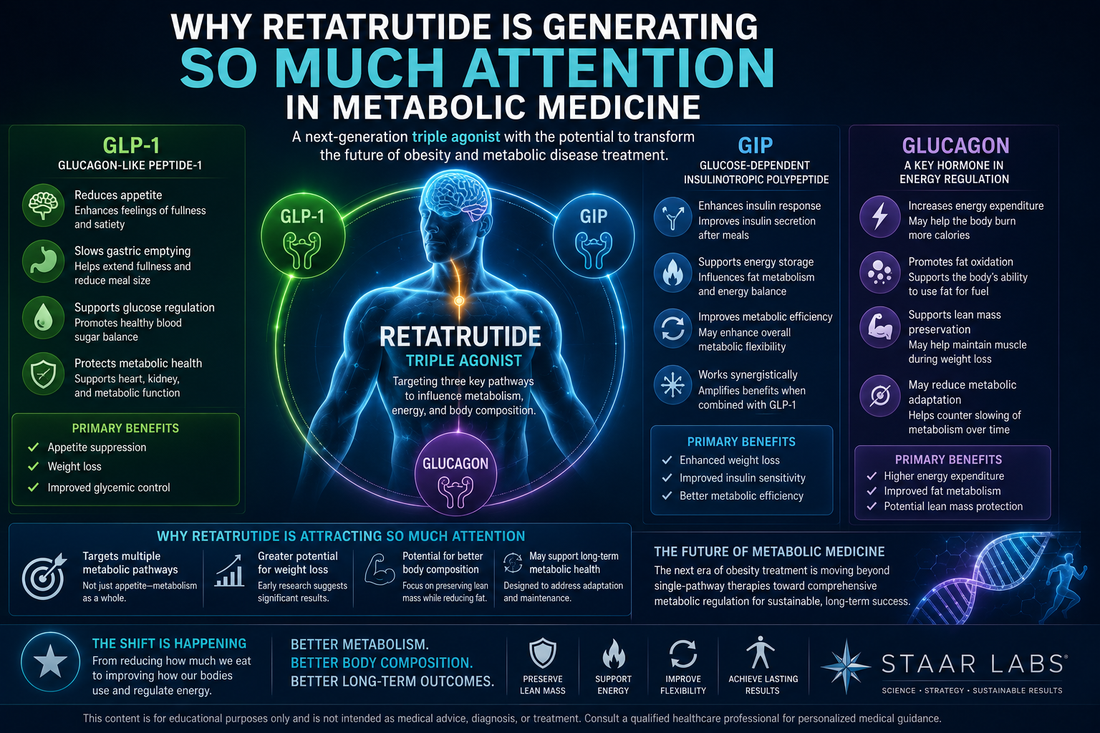
Why Retatrutide Is Generating So Much Attention in Metabolic Medicine
Share
Why Retatrutide Is Generating So Much Attention in Metabolic Medicine
Why researchers and clinicians are increasingly focused on triple-agonist metabolic therapy.
This content is provided for educational and informational purposes only and is not intended as medical advice, diagnosis, or treatment. Patients should consult qualified healthcare professionals regarding metabolic therapy and medication decisions.
In recent years, GLP-1 medications dramatically changed obesity medicine.
But many researchers now believe the next phase of metabolic therapy may involve more than appetite suppression alone.
One of the therapies generating the most attention is retatrutide — a next-generation “triple agonist” currently being studied for obesity and metabolic disease.
Unlike earlier medications that primarily targeted a single metabolic pathway, retatrutide combines activity across:
- GLP-1 receptors
- GIP receptors
- Glucagon receptors
This broader signaling approach may represent a major shift in how obesity treatment is understood.
Why Earlier GLP-1 Therapies Changed Obesity Medicine
The first major wave of GLP-1 therapies transformed obesity treatment by helping patients:
- Reduce appetite
- Improve satiety
- Lower caloric intake
- Improve glucose regulation
For many patients, this produced substantial weight loss.
However, over time clinicians also began observing several important challenges:
- Weight loss plateaus
- Metabolic adaptation
- Lean mass loss
- Reduced energy expenditure
- Long-term maintenance difficulty
These observations helped shift the conversation toward broader metabolic regulation rather than appetite suppression alone.
What Makes Retatrutide Different?
Retatrutide is attracting attention because it simultaneously targets:
- GLP-1 signaling
- GIP signaling
- Glucagon signaling
This “triple agonist” model is important because each pathway may influence metabolism differently.
Rather than focusing exclusively on reducing food intake, researchers are increasingly exploring how these pathways may collectively affect:
- Energy expenditure
- Fat oxidation
- Metabolic efficiency
- Body composition
- Long-term metabolic adaptation
The Emerging Importance of Glucagon Signaling
One of the most interesting aspects of retatrutide is the inclusion of glucagon receptor activity.
Historically, glucagon was viewed primarily as a hormone involved in raising blood glucose levels.
However, researchers later recognized that glucagon signaling may also influence:
- Energy expenditure
- Fat metabolism
- Fuel utilization
- Metabolic activity
This created growing interest in whether glucagon activity could potentially help offset some of the adaptive slowing that often occurs during prolonged weight loss.
In other words:
The future of metabolic medicine may involve improving how the body uses energy — not simply reducing how much food is eaten.
Why Body Composition Is Becoming More Important
As obesity medicine evolves, clinicians are increasingly recognizing that:
Not all weight loss is metabolically equal.
Rapid reductions in body weight may sometimes include:
- Lean mass loss
- Declining resting energy expenditure
- Metabolic adaptation
- Reduced metabolic flexibility
This is one reason future therapies may increasingly focus on:
- Body composition preservation
- Lean mass maintenance
- Metabolic resilience
- Sustainable long-term outcomes
The conversation is gradually shifting from:
“How much weight was lost?”
toward:
“What happened to metabolism, muscle, and long-term sustainability?”
Why Researchers Are Paying Attention
The interest surrounding retatrutide is not simply about larger weight loss numbers.
Researchers are increasingly interested in whether multi-pathway metabolic therapies could potentially improve:
- Long-term maintenance
- Energy regulation
- Body composition
- Metabolic adaptation
- Sustainability after weight reduction
These are some of the largest unresolved challenges in obesity medicine today.
The Future of Obesity Medicine May Look Very Different
For decades, obesity treatment largely focused on:
- calorie restriction
- willpower
- short-term dieting
The rise of GLP-1 therapy changed that framework dramatically.
Now, next-generation metabolic therapies are beginning to push the field even further toward:
- multi-pathway metabolic signaling
- body composition optimization
- maintenance-focused care
- metabolic flexibility
- long-term metabolic sustainability
As the science evolves, the future of obesity medicine may depend less on simply suppressing appetite and more on understanding how the body regulates energy as an integrated metabolic system.
Continue Exploring The Future of Metabolic Therapy
- GLP-1 vs GIP vs Glucagon: The Next Evolution of Metabolic Therapy
- The Future of Weight Loss May Depend More on Muscle Than Appetite
- Why Future GLP-1 Therapy Will Likely Focus on Maintenance — Not Just Weight Loss
- The Hidden Risk of Rapid Weight Loss in the GLP-1 Era
- Why Metabolic Flexibility May Become the Most Important Concept in Future Obesity Medicine